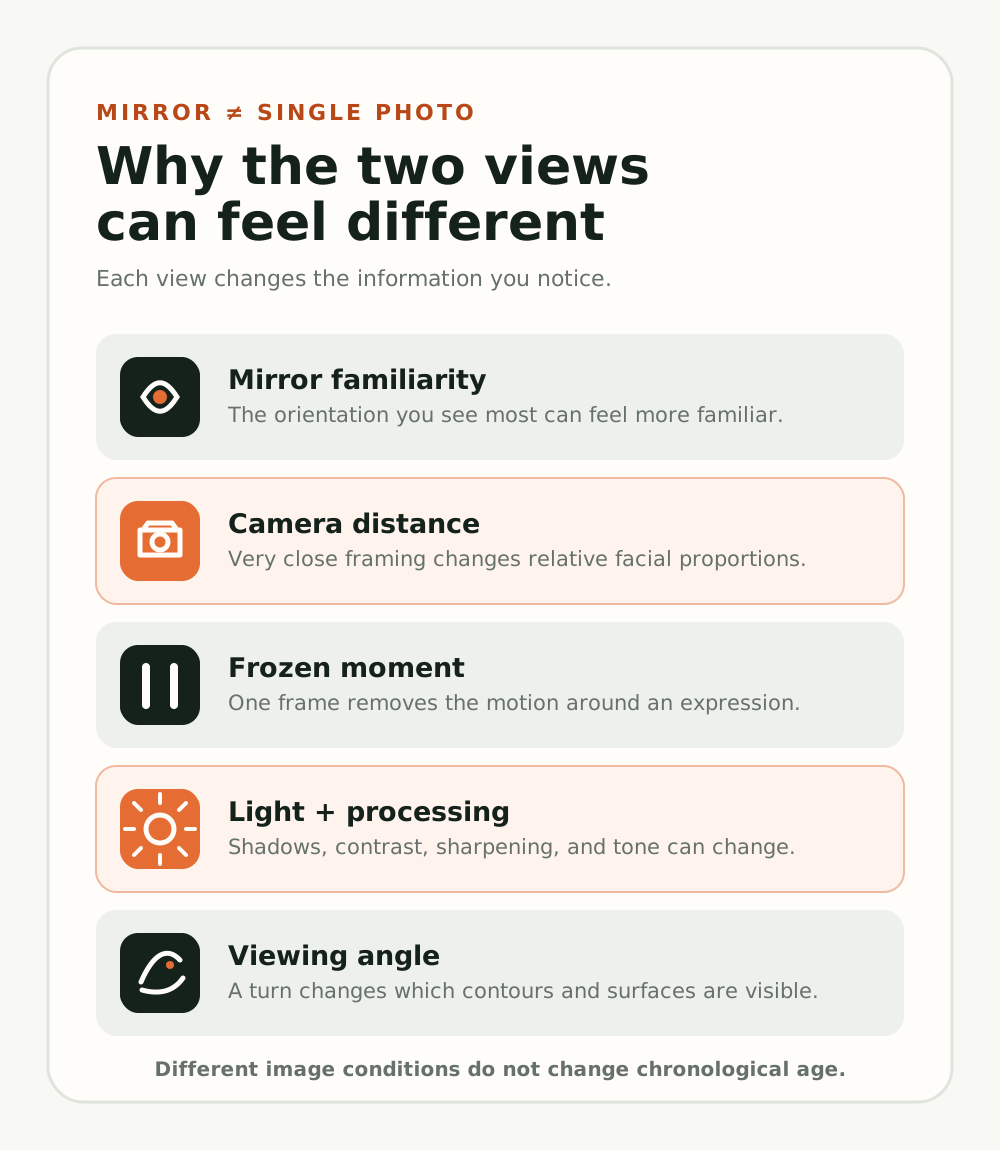
You may look older in a photo than in the mirror because five things can change the view: mirror familiarity, camera distance, a frozen moment, lighting and processing, and viewing angle. Each changes what is shown—or how familiar it feels—so test one condition at a time.
The feeling can be real even when the conclusion is too strong. A photograph can emphasize cues that you associate with age—perhaps a shadow under the eyes, a tense expression, or an unfamiliar left-right orientation. That does not mean the camera measured your chronological age, exposed your health, or showed how people see you at every moment.
What the evidence supports—and what it does not
The research behind this question studies several neighboring outcomes: preference, facial configuration, flattery, image quality, and age impressions in a limited population. The distinctions matter.
| Factor | Supported conclusion | Do not infer |
|---|---|---|
| Mirror familiarity | Repeated exposure can influence which orientation of your face feels familiar or preferable. | Your preferred mirror image is your objectively “real” face or proves a younger age. |
| Camera distance | Short distance changes perspective and measured facial proportions. | A phone or wide lens always makes every person look older. |
| Frozen frame | Motion and temporal context can affect how flattering a depiction seems. | A still-frame study directly measured perceived age. |
| Lighting and processing | Light, contrast, color, sharpening, and smoothing change visible image cues. | One lighting setup adds or removes a fixed number of years. |
| Viewing angle | Angle can change visible contours and age impressions in a controlled task. | One result applies to every face, population, and camera setup. |
Why the mirror feels more familiar
A mirror usually shows the left-right orientation of your face that you have seen most often. Most photographs show the unreversed orientation that other people more often encounter. Because faces are not perfectly symmetrical, switching orientation can make small differences feel surprisingly noticeable.
In a classic mere-exposure study by Mita, Dermer, and Knight, participants tended to prefer their mirror image while their friends showed the opposite tendency. That result concerns preference, not perceived age. The study also used a small sample of female undergraduates, so it should not be turned into a rule for everyone.
Your reflection also moves with you. You adjust your expression, posture, and angle continuously, often without noticing. A saved photo removes that feedback loop. The unfamiliarity can make the image feel “wrong” before you identify any particular feature.
Why do I look better in the mirror than my phone camera?
Familiarity may be one reason, but a phone photo also introduces camera distance, angle, processing, and a frozen expression. To isolate orientation, save the same selfie both mirrored and unmirrored without changing the frame. If your preference flips with the orientation, that points to familiarity; it does not prove that either version is more accurate.
Camera distance changes facial proportions
Perspective depends on the camera's position relative to the face. When a phone is very close, the nose and central face are nearer to the camera than the ears and sides of the face, so their relative sizes change in the image. Move the camera farther away and crop afterward, and those depth differences take up a smaller proportion of the camera distance.
A Cognition study on camera-to-subject distance found changes in facial configuration even when the final face images were resized to the same display size. A separate JAMA Facial Plastic Surgery model of short-distance selfies quantified distortion of nasal proportions. These studies support a perspective effect; the research does not show that short distance makes everyone look older.
Distance matters more than the lens label. A wide phone lens often encourages very close framing, but changing focal length without changing the camera position does not create the same perspective shift. For a fair test, move the camera back and keep the face size comparable by cropping.
Why do I look fatter in photos than in the mirror?
A close camera can make the parts of the face nearest the lens appear larger relative to the sides. That is a perspective change, not a measurement of weight or body composition. Compare a close selfie with a farther photo cropped to the same face size; if the proportions change, distance—not a hidden “real” face—was one of the variables.
A photo freezes one moment
In real life and in a mirror, an expression unfolds over time. Other people see the blink before your eyes reopen, the transition into a smile, and many small changes in the cheeks and mouth. A photo can preserve the one frame between expressions that nobody would treat as representative in motion.
The PLOS ONE “Frozen Effect” experiments found that moving videos were rated as more flattering than their component still frames across the tested stimuli. The measured outcome was flattery, not perceived age. It helps explain why an isolated frame can feel harsher, but it does not prove that motion makes a face younger.
This is also why burst mode can be useful. Several frames taken under the same conditions may look different even though the person, camera, and light did not change. Selecting a relaxed frame is not cheating; it avoids treating a transient expression as a stable feature.
Why can one picture make me look much older?
Imagine a burst taken while you move from a neutral expression into a smile. One frame may catch a squint, tightened mouth, raised cheek, or deeper temporary shadow; the frames immediately before and after may not. That everyday sequence illustrates why a single picture can feel unusually harsh without showing a stable change in your face or age.
Lighting and processing change visible cues
Light determines where highlights and shadows fall. Overhead or side light can deepen some shadows; frontal diffuse light can reduce them. The saved image can also change through exposure, white balance, contrast, sharpening, compression, and optional appearance filters. NIST's face-image-quality framework treats properties such as exposure, compression, sharpness, color, pose, and framing as separate image attributes; those attributes describe the file, not a person's true age.
A controlled study of facial photographs under several light angles found changes in some aesthetic assessments. It did not establish a simple universal age shift across every tested condition. Separately, NIST research treats illumination as an image-quality variable that can affect face-recognition performance. Recognition performance is not human perceived age, but the work reinforces a narrower point: uncontrolled light changes the evidence in a face image.
So use lighting as a comparison variable, not a verdict. If you want to learn whether one setup changes your result, keep the camera, distance, angle, expression, and processing stable while you change only the light.
Why do my wrinkles look worse in pictures?
Side or overhead light can place shadows alongside skin texture, while contrast and sharpening can make local edges more noticeable in the saved image. That does not show that the camera created new wrinkles or measured skin age. Compare the same pose under even, diffuse light using the setup in Best Photo for Age Detection, with filters and processing kept unchanged.
Viewing angle can change age impressions
A mirror commonly invites a familiar front or slight three-quarter view. Someone else may take a photo from below, above, or farther to one side. Turning the head changes which contours overlap, how much of each cheek is visible, and where light meets the surface.
A PLOS ONE study of observation angle and facial age perception found angle-related changes in its controlled task. The experiment used Japanese women as both face models and observers, with controlled lighting. That is useful evidence that angle can matter; it is not permission to assign one direction or number of years to every person or population.
If a photo taken from an unfamiliar angle looks older to you, describe the concrete change first: stronger side contour, different under-eye shadow, more visible jawline, or a different facial proportion. That is more informative than assuming the frame has uncovered a hidden truth.
Why does my face look older from some angles?
A common group-photo setup combines a camera slightly below eye level, a head turned toward the photographer, and light arriving from one side. The result may emphasize different contours and shadows than your usual mirror position. Recreate the shot at eye level while holding distance, expression, and light steady; otherwise angle and lighting remain tangled together.
Run a fair two-photo comparison
The fastest way to separate these factors is to make a controlled pair. The aim is not to manufacture a younger-looking image. It is to discover which image condition changed what you saw.
- Use one phone and turn off beauty filters or appearance-changing effects.
- Take a relaxed, front-facing baseline in even light from a comfortable portrait distance.
- Keep the camera, crop, expression, and light stable. Change one variable only—distance, angle, or light.
- Take several frames in each condition so one blink or half-expression does not decide the comparison.
- Compare the original files side by side. If you also test apparent age, use the same browser-side age guesser for both and repeat the pair before interpreting a change.
Repeat the pair on another day before treating the result as a pattern. A stricter setup keeps focus, crop, filters, occlusion, and lighting from changing together.
What this comparison cannot tell you
A photo comparison is not an assessment of health, attractiveness, identity, biological age, or chronological age. It shows how one image condition changes a depiction. An AI result is also an apparent-age estimate from visible pixels, not proof of a birthday or a diagnosis.
If the tool gives two different numbers, read AI Age Guesser vs Real Age before assigning meaning to the difference. A repeatable photo setup improves the experiment; it does not turn an impression into objective truth.
Photos versus the mirror FAQ
Why do I look older in photos than in the mirror?
Photos can change facial proportions, freeze one expression, and record different lighting or angles. You may also be less familiar with your unreversed face. None of those factors reveals a single true age.
Is the mirror or a photo more accurate?
Neither is a complete objective view. A mirror is live and laterally reversed, while a photo is a flat frozen image shaped by camera distance, angle, lighting, processing, and the chosen moment.
Does a phone camera make you look older?
There is no fixed effect. A very short camera distance can change facial proportions, but research does not show that every phone camera makes every person look older.
How can I compare two photos fairly?
Use the same camera, distance, angle, lighting, expression, crop, and editing. Then change one condition at a time and repeat the pair before drawing a conclusion.
If you use an online age tool for the comparison, first check how it handles your selected face photo.
Continue exploring
Sources and further reading
- Journal of Personality and Social Psychology: Reversed facial images and the mere-exposure hypothesis
- Cognition: Camera-to-subject distance affects face configuration and perceived identity
- JAMA Facial Plastic Surgery: Nasal distortion in short-distance photographs
- PLOS ONE: The Frozen Effect
- Aesthetic Surgery Journal Open Forum: Light angle and aesthetic perception of the face
- NIST: Quantifying how lighting and focus affect face recognition performance
- NISTIR 8485: Face Image Quality Vector Assessment
- PLOS ONE: Observation angles and facial age perceptions in Japanese women