An AI age guesser estimates apparent age: how old a face looks in one photo. Your real, chronological age is a fixed fact based on your birthday. The two can differ because a model sees image evidence, not your personal history.
If AI guessed your age wrong, the useful question is not "what is wrong with my face?" It is "what did this particular photo show the model?" Lighting, perspective, expression, editing, crop, and model design can all change an age estimate without changing the person.
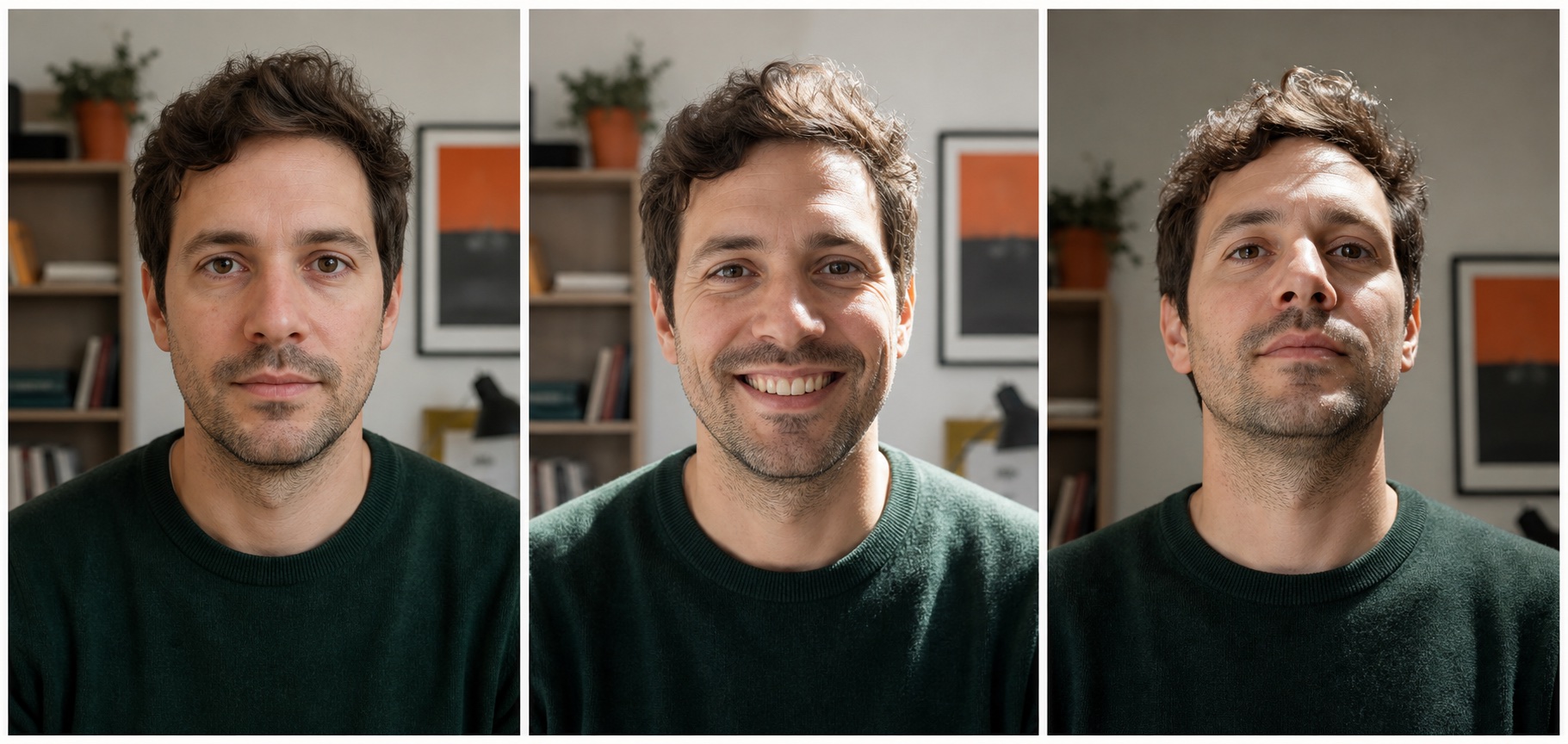
Apparent age vs real age
Researchers treat these as separate prediction targets. The APPA-REAL dataset paper includes both real-age labels and apparent-age ratings because perceived age is not simply a noisy version of a birthday. It is a distinct judgment.
| Question | Real or chronological age | Apparent or perceived age |
|---|---|---|
| What is it? | Time since a person's birth. | How old the person appears in a specific image. |
| Is it fixed? | Yes, relative to the current date. | No. It may vary by photo, observer, and model. |
| Where does it come from? | Reliable records such as a birth certificate. | Visible cues interpreted by people or an algorithm. |
| What can a selfie prove? | Nothing about a verified birthday. | Only an estimate about how that selfie reads. |
Biological age is also different. It is a health-related concept that cannot be measured by this site from a face photo. A playful photo age estimate should not be rewritten as a wellness score or medical conclusion.
Why an AI age guess can differ from your actual age
Apparent age has no single perfect label
Even people disagree when estimating age from a face. A Royal Society Open Science study using standardized passport photographs found systematic estimation errors and showed that a previous face could influence the next judgment. Human-rated apparent age is therefore a distribution of opinions, not an objective date hidden inside the pixels.
Training data defines what the model learns
An age model learns patterns from labeled examples. Those labels may represent chronological age, averages of human apparent-age ratings, or grouped age bands. The age distribution, image style, and representation of different populations in the training set all influence performance. A model trained on one kind of image may not react identically to a close selfie, studio portrait, or compressed social-media photo.
One photo is a narrow sample
People see you across movement, expressions, distances, and lighting conditions. A model receives one frozen crop. Hair, glasses, makeup, facial hair, and expression may become prominent in that crop, even though none of them changes your real age.
Why do I look older or younger in different photos?
Camera distance and perspective
A close selfie changes facial proportions. Distance, not the lens label alone, is the central perspective variable.
Lighting and shadows
Light direction changes contrast and the visibility of texture. It does not add a fixed number of years to every face.
Expression and head angle
Smiles, squints, raised brows, or a turned head alter the shapes and lines visible to the model.
Color and filters
Contrast, saturation, smoothing, and color shifts can change apparent-age cues or remove detail.
Crop and face size
A tiny face gives the model fewer usable pixels; a tight crop may remove contextual cues.
Blur and compression
Motion blur and repeated image compression soften edges and texture that were present in the original.
Research on camera-to-subject distance shows that changing distance alters photographed facial configuration even when the final face is displayed at the same size. This helps explain why a close phone selfie and a portrait taken farther away can look surprisingly different.
Why two AI age guessers disagree
Two online age detectors can receive the same photo and still return different numbers because their pipelines are not identical:
- Face detection and crop: each tool may include a different amount of forehead, hair, neck, or background.
- Alignment: landmark mapping can rotate or normalize the face differently.
- Training target: one model may learn real age while another learns human-rated apparent age.
- Training examples: datasets differ in age balance, demographics, camera quality, pose, and editing.
- Output method: a tool may round one prediction, average several models, or convert a distribution into one number.
Disagreement does not automatically prove that one tool is broken. It shows why a single estimate should not carry the authority of a verified record.
How accurate is an AI age guesser?
"Accurate" needs a defined test. Is the model being compared with birthdays or with average human ratings? Which age groups and image conditions are represented? Is the reported number a mean absolute error across a dataset or an individual guarantee?
Those questions matter because dataset averages hide variation between people and photos. The NIST age estimation evaluation examines performance across different image and demographic conditions rather than treating one score as universal. This site therefore does not promise that every estimate will fall within a fixed number of years.
Face detection confidence is not age confidence. A system can be very sure that it found a face while still being uncertain about the apparent-age estimate.
How to run a fair photo comparison
Use the experiment to learn how image conditions affect a result, not to chase the youngest possible number.
- Choose one unfiltered, front-facing baseline photo in even light.
- Take a second photo with the same camera, distance, crop, pose, and expression.
- Change one variable only: for example, light direction, glasses, or expression.
- Use the same age guesser for both images so you are not mixing model differences with photo differences.
- Record the pair or range. Re-test a surprising result with another controlled photo.
For input guidance, use the best photo for age detection checklist. Then run the comparison with the browser-side AI age guesser.
How to interpret your result
A useful reading is: "This is how old the model estimates I appear in this photo." It does not answer:
- What is my verified date of birth?
- Am I healthy or aging well?
- Does this person meet an age-restricted requirement?
- Should an employer, insurer, school, or service treat this person differently?
Do not use the result for identity checks, legal decisions, medical decisions, access control, or age verification. A photo estimate is not proof, even when it happens to match real age.
AI age guesser FAQ
Is apparent age the same as real age?
No. Real age is time since birth. Apparent age is how old someone appears in a particular image and can vary by observer, photo, or model.
Why does AI think I look older than I am?
The model may respond to the light, camera distance, angle, expression, crop, color, or texture visible in that photo. A higher estimate is not a diagnosis or judgment about your health.
Can lighting change an AI age estimate?
Yes, because light changes shadows, highlights, contrast, and visible texture. The direction and size of the change are not fixed for every person.
Do selfie cameras change how old you look?
Very close camera distance changes perspective and facial proportions. A portrait from farther away can provide different image evidence.
Why do different age guessers give different ages?
Tools can use different detectors, crops, training data, age labels, models, and rounding methods, so disagreement is expected.
Can an AI age guesser verify someone's age?
No. It should not be used as legal or identity proof or to make eligibility and access decisions.
Continue exploring
Sources and further reading
- APPA-REAL: Apparent and Real Age Estimation in Still Images
- Royal Society Open Science: Two sources of bias explain errors in facial age estimation
- CVPR Workshops: From Apparent to Real Age - bias analysis
- Cognition: Camera-to-subject distance affects face configuration
- Scientific Reports: Colour information biases facial age estimation